Between the Front & Back: Grundle’s Book Club

My hardback copy for $28.99 arrives tomorrow. Thanks a lot Grumble for picking the non paperback book.
 
My hardback copy for $28.99 arrives tomorrow. Thanks a lot Grumble for picking the non paperback book.
Ha, whoops.

OK, we'll push it another week. Of the handful of people doing this, most haven't finished the book.
 
My hardback copy for $28.99 arrives tomorrow. Thanks a lot Grumble for picking the non paperback book.
Ha, whoops.

OK, we'll push it another week. Of the handful of people doing this, most haven't finished the book.

I'd prefer the last week of the month.

I got side tracked with Apocolypse Never.

Even if I'm not done with Maps I will still be able to fake my way through and share some good insight. I graduated from a Public Ivy in 4 years w/o reading most of the books so I'll be fine.
 
My hardback copy for $28.99 arrives tomorrow. Thanks a lot Grumble for picking the non paperback book.

Lol...Amazon just dropped my hardback off a couple hours ago. I’ve got some catching up to do.
 
Last edited:
My hardback copy for $28.99 arrives tomorrow. Thanks a lot Grumble for picking the non paperback book.

Lol...Amazon just dropped my hardback off a couple hours ago. I’ve got some catching up to do.

I just got mine off the front porch.
 
I'm gonna skip this one and hop on for next month's book:

View attachment 38449

One of my beard's beast friends has colon cancer, and she ordered this masterpiece for her as a gag gift. Remember, this is "The Trilogy," so it's three books bound into one.

It's like 40 pages. Total. I've seen bigger instruction manuals for computer motherboards.

I'll cut to the chase: If this isn't next month's HCH book club book, I'm gone, just gone.

gopkfyb9krvg.jpg
 
Last edited:
I'm gonna skip this one and hop on for next month's book:

View attachment 38449

One of my beard's beast friends has colon cancer, and she ordered this masterpiece for her as a gag gift. Remember, this is "The Trilogy," so it's three books bound into one.

It's like 40 pages. Total. I've seen bigger instruction manuals for computer motherboards.

I'll cut to the chase: If this isn't next month's HCH book club book, I'm gone, just gone.

View attachment 38525

rsawfdi.gif

 
Alright, tim has come to kvetch about this book. I'll be poasting some thoughts a little later this morning. I'm genuinely curious to hear what other's got out of this book.
 
1. The US shale gas & oil revolution.[/b]

Obviously this one of main thrusts of the book, and one of my big takeaways. I consider myself decently well-read about US news at the topline. I cannot recall reading much if anything about this separate from a partisan view. Plenty of "shale gas will poison water" or "greens are trying to kill jobs." Not much about how impactful this was domestically and internationally. This was a huge eye-opener.

A close corollary to this point, eye-opening reading just how good[/i] the US economy was pre-Vid. Wow, just wow.

Question for my oil & gas guysm: The book makes mention of the short-cycle nature of fracking wells, versus the long-cycle of conventional wells like in Middle East or South America. Out of the scope of the book is the pros and cons of that. Anyone care to expound?

Another related anecdote from the: In 2015 (I think? maybe earlier), Venezuela proposed in an OPEC meeting to push propaganda in the US about the environmental horrors of fracking. Fuck those guys.

 
2. Maps[/b]

Literally, maps. The book has a section early on about China laying claims to expanded areas of the South China Sea, using historical maps as a validation of the claims. Like really old maps. Then Vietnam counters with their own old maps.

Queery for my international law guysm: Do those kind of documents have standing?
 
1. The US shale gas & oil revolution.[/b]

Obviously this one of main thrusts of the book, and one of my big takeaways. I consider myself decently well-read about US news at the topline. I cannot recall reading much if anything about this separate from a partisan view. Plenty of "shale gas will poison water" or "greens are trying to kill jobs." Not much about how impactful this was domestically and internationally. This was a huge eye-opener.

A close corollary to this point, eye-opening reading just how good[/i] the US economy was pre-Vid. Wow, just wow.

Question for my oil & gas guysm: The book makes mention of the short-cycle nature of fracking wells, versus the long-cycle of conventional wells like in Middle East or South America. Out of the scope of the book is the pros and cons of that. Anyone care to expound?

Another related anecdote from the: In 2015 (I think? maybe earlier), Venezuela proposed in an OPEC meeting to push propaganda in the US about the environmental horrors of fracking. Fuck those guys.

We'd be beyond fucked right now without shale.

The bit about "net" imports intrigued me. Our? refineries were built to process heavy crude and not the lighter stuff. So we? still import oil because it's cheaper than re-fitting the refineries, but are no longer a big "net" important based on our exports of oil.
 
3. Iran[/b]

Seriously, fuck those guys. I've read a ton of books in the last several years that have some touch point in the Middle East, mostly from a "war on terror" perspective. Iran comes up a lot in those, natch. However, this book for me really crystalized that amount of malarkey the Iranian government drops across the region. Directly or through proxies, Iran seems to responsible for at least 81% of the troubles in the region. Weº know they hate usº, this is understood, but let's not loose sight of how much Iran seems to hate every other ME government.

Aside 1: Who knew that Houthi isn't an ethnic minority group, but an Islamist rebel group named after their former leader who was vaporized by the Saudis? I did not. Just from snips and headlines covering SA's actions against them, I had the impression that Houthis vs. Saudis was something akin to Shiite vs. Sunni. Nope, Iranian backed guerrillas.

Aside 2: What a clusterfuck de-Baathification was in Iraq. Terrible decision.
 
I'm about half way through. Done with the US and Ruskie maps and almost completed with the Chinese one. @PurpleBaze map is next.

Our? journey with China has been such a clusterfuck. First, we "open" China further the Cold War wedge between the Soviets and the PRC. This begins the process of the China becoming a major economic power over the coming decades and thus a massive consumer of energy. And now we are back to square one with the Chinese and Russians thick as thieves yet again, albeit for different reasons than the early 1950s.

tenor.gif


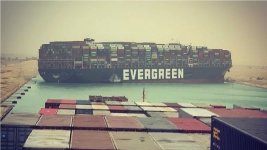
4. Shoutout to the Container Guy[/b]

"No engine, no wheels, no sails." Not much to say here other than big ups to the guy from Virginia (I think) how invented containerized shipping.
b33zxhkga3ve.jpg
 
Refining guy, so oil and gas adjacent, I guess. My insight into your question comes from both what we see coming into our plant, the difficulties in running it, and also anecdotal insight from my brother in law.

1.) You are correct that the Dakota shale gas is way too light to run at a high percentage of crude diet. We call it "black IPA" because it's basically naphtha with some black dye added. The "environmentalists" are not wrong in that shipping that shit by rail across the country with our current rail infrastructure (a lot of single-wall cars, for example) is incredibly irresponsible and dangerous. We're rolling giant bombs around the country on old, rickety rail infrastructure. The only other crude I've seen that's in the same ballpark as bakken shale is that Russian Vityaz shit. In both cases, it's basically crude in, naphtha out.

Interestingly, though, refineries all over are reconfiguring to handle lighter crude diets. We did so in 2017, with a pretty massive capital project. We can run WAY lighter than we used to be able to. Mostly, though, this is to be able to run lighter Canadian pipeline crudes that we get on the relative cheap. Huge moneymaker. We only run domestic shale if it's at a price we can't refuse, as it's still pretty difficult to run. Which leads to...

2.) Yes, I can totally see that fracking wells are more susceptible to price fluctuations than traditional, large wells. For starters, they're just more expensive to operate. I mentioned ERoEI in another thread. Fracking wells are much lower ERoEI than traditional wells. When margins are lower, it's really boom or bust. Another example of this that I've experienced is Alberta tar sands crude (wanna talk about an ecological disaster...). When oil peaked at over $140 per barrel in 2008 or so, tar sands crude was all the rage, and we were running (PAINFULLY) as much of it as we could. Again, though, I believe this peaked at our plant at something like 17% of diet, as this shit gave us trouble in exactly the opposite direction: all bottoms. When crude is $140 per, and you can get tar sand crude for $90, it's a no-brainer. Then oil drops to normal price. Funny, we don't see much Albian heavy in the diet anymore. I've often wondered how they're doing up there.

3.) The second anecdotal evidence I have to support the boom or bust theory for fracking wells is the actual boom and bust that my brother in law experienced in North Dakota. He followed the black gold rush over there, worked a pressure testing rig for a while, then borrowed some money and started his own pressure testing business. At his peak, he was rolling five rigs and was killing it, then the Saudis opened the faucet and his business went TU. After selling all of his equipment at a decent discount, he was able to pay off all of his creditors and get out with low six figures to show for his five years over there. Sad story.

At this point, I can't even remember what question I'm supposed to be answering here, so I'm just going to leave it at this.
 
Refining guy, so oil and gas adjacent, I guess. My insight into your question comes from both what we see coming into our plant, the difficulties in running it, and also anecdotal insight from my brother in law.

1.) You are correct that the Dakota shale gas is way too light to run at a high percentage of crude diet. We call it "black IPA" because it's basically naphtha with some black dye added. The "environmentalists" are not wrong in that shipping that shit by rail across the country with our current rail infrastructure (a lot of single-wall cars, for example) is incredibly irresponsible and dangerous. We're rolling giant bombs around the country on old, rickety rail infrastructure. The only other crude I've seen that's in the same ballpark as bakken shale is that Russian Vityaz shit. In both cases, it's basically crude in, naphtha out.

Interestingly, though, refineries all over are reconfiguring to handle lighter crude diets. We did so in 2017, with a pretty massive capital project. We can run WAY lighter than we used to be able to. Mostly, though, this is to be able to run lighter Canadian pipeline crudes that we get on the relative cheap. Huge moneymaker. We only run domestic shale if it's at a price we can't refuse, as it's still pretty difficult to run. Which leads to...

2.) Yes, I can totally see that fracking wells are more susceptible to price fluctuations than traditional, large wells. For starters, they're just more expensive to operate. I mentioned ERoEI in another thread. Fracking wells are much lower ERoEI than traditional wells. When margins are lower, it's really boom or bust. Another example of this that I've experienced is Alberta tar sands crude (wanna talk about an ecological disaster...). When oil peaked at over $140 per barrel in 2008 or so, tar sands crude was all the rage, and we were running (PAINFULLY) as much of it as we could. Again, though, I believe this peaked at our plant at something like 17% of diet, as this shit gave us trouble in exactly the opposite direction: all bottoms. When crude is $140 per, and you can get tar sand crude for $90, it's a no-brainer. Then oil drops to normal price. Funny, we don't see much Albian heavy in the diet anymore. I've often wondered how they're doing up there.

3.) The second anecdotal evidence I have to support the boom or bust theory for fracking wells is the actual boom and bust that my brother in law experienced in North Dakota. He followed the black gold rush over there, worked a pressure testing rig for a while, then borrowed some money and started his own pressure testing business. At his peak, he was rolling five rigs and was killing it, then the Saudis opened the faucet and his business went TU. After selling all of his equipment at a decent discount, he was able to pay off all of his creditors and get out with low six figures to show for his five years over there. Sad story.

At this point, I can't even remember what question I'm supposed to be answering here, so I'm just going to leave it at this.

I understood some of that on first pass, will read again. Thanks.
 
Back
Top