
By Derek Johnson
It has been quite a January so far. As we know, Demond Williams Jr., the fleet-footed quarterback with a cannon arm and a sophomore's swagger, lit a fuse that nearly blew apart Washington coach Jedd Fisch's efforts to rebuild UW football. Fresh off a $4.5 million NIL deal that screamed "LFG!," Williams announced his bolt to the transfer portal on January 6—timing it disastrously amid a memorial for fallen soccer star Mia Hamant. Whispers of LSU's Lane Kiffin dangling an extra $2 million, or Alabama's siren call, swirled like fog off Lake Washington.
But UW brass, seeing breach of contract, rattled sabers of legal war. Two days later, Williams reversed, pledging fealty anew. Fisch, not known for wielding an iron fist, navigated the chaos with "heartfelt conversations," downplaying locker room rifts and framing it as the brutal churn of NIL-era football. He mended fences publicly, assuring fans Williams remained his starter, a nod to the game's mercenary evolution where talent is currency and commitments fragile as autumn leaves.
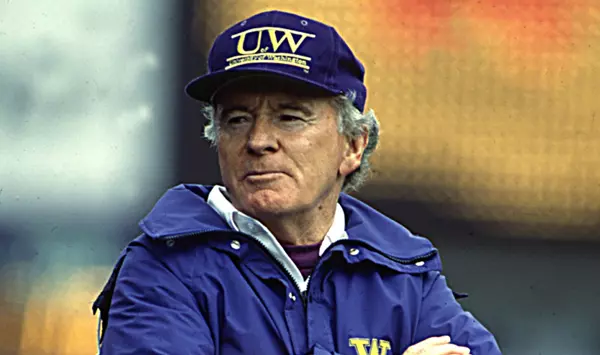
Ah, but summon the shade of Don James, the Dawgfather himself, and the tale takes on a different tone.
James, who ruled Montlake from 1975-1992 with the precision of a Swiss watchmaker, built champions not on deals but on ironclad ethos. His Huskies weren't just teams; they were regiments, drilled in yellow-paged manifestos of character: strive, commit, endure. “Whatever It Takes” and “Nothing but Roses” were typical team-wide slogans for seasons in the early 1990s.
And no portals in his day—transfers meant sitting a year. So there are limits to comparing coaches from different eras in football. But James, aloof from his practice tower yet deeply paternal, demanded loyalty as oxygen. He'd have seen Williams's contractual flip as a betrayal of the pack, a crack in the foundation he mortared with sweat and strategy.
Picture it: James, eyes like polished steel, summoning the kid to his office in the old Tubby Graves Building. Maybe there would be an accompanying parent. But no agents hovering, no NIL lawyers parsing clauses—just man to man, coach to charge. "Demond," I believe he’d say, “You signed on for the fight, the grind, the glory shared. I expect you to honor it" Discipline would follow: extra laps, maybe even limited bench time, a lesson in humility before performing again amid the roar of 70,000 faithful.
I had a personal experience with Coach James that reflected this ethos. In July 2004, I interviewed James at an empty Husky Stadium. For two hours he went into detail about how and why he had resigned as UW coach in 1993 in protest of Pac-10 sanctions and then-UW president Bill Gerberding. James had never disclosed the story publicly before.
As I wrote the story, I knew I had something special. At the time, I was a columnist for Dawgman.com and Sports Washington magazine. When finished, I called up coach James and asked him if it was okay if I offered it to The Seattle Times, since he had graciously given me that interview and had felt betrayed in the past by The Times. I had called James during dinner and I remember hearing him chewing while we talked. “You still write for Dawgman.com and Sports Washington?” he asked between bites. Yes, I said. “Well then, I think you should show loyalty to the one paying you and publish it through them,” he said. “But of course, it’s up to you.”
“Yes, I hear you loud and clear,” I said, suddenly smiling sheepishly and as I was reminded of what was important.
“Well, I’ve given you the story,” he said. “Run with it.” Then we hung up.
(You can find that story today in the Dawgman archives, but they have since replaced my name with Chris Fetters’ name on the byline).
“Molder of Men” has become almost a joking pejorative since the days of Tyrone Willingham at Washington. But there’s truth to the moniker in the life of a college football coach. Don James molded men like Joe Steele, Napoleon Kaufman and Dave Hoffmann through such crucibles, forging a 1991 national title from largely from talent and resolve. In the current analysis, Fisch adapts to the portal's wild west; James I suspect would have largely tamed it, turning turmoil into testament. In his world, stalwarts wouldn’t portal-hop as much—they’d endure, emerging unbreakable much like today’s Indiana Hoosiers.
Washington football, ever the bridge between eras, aches to see that unyielding and maybe even paternal grip once again.


