Last edited by a moderator:

You are using an out of date browser. It may not display this or other websites correctly.
You should upgrade or use an alternative browser.
You should upgrade or use an alternative browser.
Where Should Big Ten Expand Next?
- Thread starter trublue
- Start date

greenblood
New Fish
It's a given that Oregon and Washington are the next two dominos to fall

Empty Husky stadium is the best empty stadium.
POTD.
LOL . . .
Doesn’t it matter how many butts are in the seats?
See UCLA, Cal and Warshington.
So much butthurt here


46XiJCAB
New Fish
Empty Husky stadium is the best empty stadium.
POTD.
LOL . . .
Doesn’t it matter how many butts are in the seats?
See UCLA, Cal and Warshington.
So much butthurt here
Mocking Haie shit poast = butthurt to Haie.
Lol.....
46XiJCAB
New Fish
46XiJCAB
New Fish
LOL . . .
Doesn’t it matter how many butts are in the seats?
See UCLA, Cal and Warshington.
Stop crying!
You guys have a smallerthan fucking UAB! LOL
So…do you. You can’t comprehend your own linked graphic?

LOL . . .
Doesn’t it matter how many butts are in the seats?
See UCLA, Cal and Warshington.
No, because the capacity is important for the fanbases of the traveling Midwest fanbases. Doesn't matter how many locals are going to UW or Oregon games.
You guys have a smaller
So…do you. You can’t comprehend your own linked graphic?
It's a joke dude. Stadium capacity has nothing to do with how attractive you are.
It's just easy to troll duck fans since they have a small stadium relative to statewide support of the program.
I played in an empty Autzen against a 7 on 7 team of some (very) lightly recruited players and it's crazy how small it looks when it's empty.
Also played in CenturyLink or whatever it is now in a non con game in high school, and you can see the difference between Autzen and that/husky stadium.
Maybe duck fans like it that way. Dunno.
Last edited:
greenblood
New Fish
Oregon definitely needs to increase the capacity, as they average above capacity on a weekly basis. Oregon has been hesitant to increase because they don't want to mess with the fan noise. It's kind of stupid, but that really is an issue with them. Changing the stadium dimensions can hurt the "bowl effect" the current design has. It's a great home field advantage, but I think Oregon is good enough now, that it's not as important as it used to be.
Academics, stadium size, home market size do matter, they just don't matter like they used to. The biggest driver is your overall market engagement. Basically, what schools move the needle.
Vanderbilt and northwestern have top notch academics. How much does that help the SEC or B1G?
Stadium size might create a great environment, but that only impacts the individual schools bottom line, not the conference.
Rutgers and Maryland (DC and New Jersey) provide great home markets, but you can argue that they are monetary losers for the B1G. Outside of B1G subscriptions, home market size is pretty irrelevant.
There are a ton of schools (Alabama being one of them) that do not have huge home markets, but move the needle nationally. You can argue all you want, but Oregon has a brand that moves the needle. They generate larger ratings than most, and that provides added value for the TV deal. Oregon and Washington are both highly attractive to the B1G.
Stanford and Cal are great academically, and are in a large market. However, their fans don't give a shit, shown by being around 50% capacity each week, and the abundance of apathy nationally towards their programs. For these reasons, Cal and Stanford are not as attractive as Oregon and Washington.
I'm more than confident that the B1G ten is looking to only add 2 more west coast teams (Oregon and Washington). That will bring in four west coast teams. It will make traveling easier, while also maximizing west coast value and avoid diluting the overall conference value. Then, I think they will get to 20 by reaching out to the ACC if the GOR gets figured out. Their biggest targets east looks to be North Carolina and Florida St.
Notre Dame is their dream, but Notre Dame isn't giving up independence unless forced to, and that isn't happening any time soon. They also have no incentive to move quickly, as they know either the SEC or B1G would accept their application immediately.
Academics, stadium size, home market size do matter, they just don't matter like they used to. The biggest driver is your overall market engagement. Basically, what schools move the needle.
Vanderbilt and northwestern have top notch academics. How much does that help the SEC or B1G?
Stadium size might create a great environment, but that only impacts the individual schools bottom line, not the conference.
Rutgers and Maryland (DC and New Jersey) provide great home markets, but you can argue that they are monetary losers for the B1G. Outside of B1G subscriptions, home market size is pretty irrelevant.
There are a ton of schools (Alabama being one of them) that do not have huge home markets, but move the needle nationally. You can argue all you want, but Oregon has a brand that moves the needle. They generate larger ratings than most, and that provides added value for the TV deal. Oregon and Washington are both highly attractive to the B1G.
Stanford and Cal are great academically, and are in a large market. However, their fans don't give a shit, shown by being around 50% capacity each week, and the abundance of apathy nationally towards their programs. For these reasons, Cal and Stanford are not as attractive as Oregon and Washington.
I'm more than confident that the B1G ten is looking to only add 2 more west coast teams (Oregon and Washington). That will bring in four west coast teams. It will make traveling easier, while also maximizing west coast value and avoid diluting the overall conference value. Then, I think they will get to 20 by reaching out to the ACC if the GOR gets figured out. Their biggest targets east looks to be North Carolina and Florida St.
Notre Dame is their dream, but Notre Dame isn't giving up independence unless forced to, and that isn't happening any time soon. They also have no incentive to move quickly, as they know either the SEC or B1G would accept their application immediately.
Last edited:
greenblood
New Fish
However much we hate it. Oregon and Washington are stronger as a couple than individually for realignment. Oregon and Washington bring the PNW, a great rivalry, and close proximity for traveling to each other quite easily.
Hopefully that's what's happening. In all honesty, I'd hate for Oregon to go to the B1G without Washington. I'm sure most Washington fans here don't feel that why going the other way, but that's just my opinion. A conference is much better with Oregon and Washington than one or the other. The B1G knows this.
For future survival I think Oregon and Washington admins, should be working together to make it happen.
Hopefully that's what's happening. In all honesty, I'd hate for Oregon to go to the B1G without Washington. I'm sure most Washington fans here don't feel that why going the other way, but that's just my opinion. A conference is much better with Oregon and Washington than one or the other. The B1G knows this.
For future survival I think Oregon and Washington admins, should be working together to make it happen.
Last edited:

I thought Oregon already lost the big noise advantage after the remodel. Partly because it started to cost real money so the riff raff didn't show but also because it expanded
The 2000 game hurt my ears
Similar to Husky Stadium. The old 60,000 place was louder than the expanded 72,000
Again because of cost keeping out the Auburn and Kent fans it became a lot less rabid
The 2000 game hurt my ears
Similar to Husky Stadium. The old 60,000 place was louder than the expanded 72,000
Again because of cost keeping out the Auburn and Kent fans it became a lot less rabid
Oregon definitely needs to increase the capacity, as they average above capacity on a weekly basis. Oregon has been hesitant to increase because they don't want to mess with the fan noise. It's kind of stupid, but that really is an issue with them. Changing the stadium dimensions can hurt the "bowl effect" the current design has. It's a great home field advantage, but I think Oregon is good enough now, that it's not as important as it used to be.
Academics, stadium size, home market size do matter, they just don't matter like they used to. The biggest driver is your overall market engagement. Basically, what schools move the needle.
Vanderbilt and northwestern have top notch academics. How much does that help the SEC or B1G?
Stadium size might create a great environment, but that only impacts the individual schools bottom line, not the conference.
Rutgers and Maryland (DC and New Jersey) provide great home markets, but you can argue that they are monetary losers for the B1G. Outside of B1G subscriptions, home market size is pretty irrelevant.
There are a ton of schools (Alabama being one of them) that do not have huge home markets, but move the needle nationally. You can argue all you want, but Oregon has a brand that moves the needle. They generate larger ratings than most, and that provides added value for the TV deal. Oregon and Washington are both highly attractive to the B1G.
Stanford and Cal are great academically, and are in a large market. However, their fans don't give a shit, shown by being around 50% capacity each week, and the abundance of apathy nationally towards their programs. For these reasons, Cal and Stanford are not as attractive as Oregon and Washington.
I'm more than confident that the B1G ten is looking to only add 2 more west coast teams (Oregon and Washington). That will bring in four west coast teams. It will make traveling easier, while also maximizing west coast value and avoid diluting the overall conference value. Then, I think they will get to 20 by reaching out to the ACC if the GOR gets figured out. Their biggest targets east looks to be North Carolina and Florida St.
Notre Dame is their dream, but Notre Dame isn't giving up independence unless forced to, and that isn't happening any time soon. They also have no incentive to move quickly, as they know either the SEC or B1G would accept their application immediately.
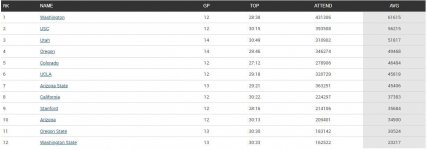
According to the PAC-12, UO didn't have a sellout crowd last year. 54k capacity.
greenblood
New Fish
Oregon definitely needs to increase the capacity, as they average above capacity on a weekly basis. Oregon has been hesitant to increase because they don't want to mess with the fan noise. It's kind of stupid, but that really is an issue with them. Changing the stadium dimensions can hurt the "bowl effect" the current design has. It's a great home field advantage, but I think Oregon is good enough now, that it's not as important as it used to be.
Academics, stadium size, home market size do matter, they just don't matter like they used to. The biggest driver is your overall market engagement. Basically, what schools move the needle.
Vanderbilt and northwestern have top notch academics. How much does that help the SEC or B1G?
Stadium size might create a great environment, but that only impacts the individual schools bottom line, not the conference.
Rutgers and Maryland (DC and New Jersey) provide great home markets, but you can argue that they are monetary losers for the B1G. Outside of B1G subscriptions, home market size is pretty irrelevant.
There are a ton of schools (Alabama being one of them) that do not have huge home markets, but move the needle nationally. You can argue all you want, but Oregon has a brand that moves the needle. They generate larger ratings than most, and that provides added value for the TV deal. Oregon and Washington are both highly attractive to the B1G.
Stanford and Cal are great academically, and are in a large market. However, their fans don't give a shit, shown by being around 50% capacity each week, and the abundance of apathy nationally towards their programs. For these reasons, Cal and Stanford are not as attractive as Oregon and Washington.
I'm more than confident that the B1G ten is looking to only add 2 more west coast teams (Oregon and Washington). That will bring in four west coast teams. It will make traveling easier, while also maximizing west coast value and avoid diluting the overall conference value. Then, I think they will get to 20 by reaching out to the ACC if the GOR gets figured out. Their biggest targets east looks to be North Carolina and Florida St.
Notre Dame is their dream, but Notre Dame isn't giving up independence unless forced to, and that isn't happening any time soon. They also have no incentive to move quickly, as they know either the SEC or B1G would accept their application immediately.
According to the PAC-12, UO didn't have a sellout crowd last year. 54k capacity.
View attachment 51608
I was going off of what was said as of 2019. Looking game by game in 2021. 43k for both Fresno at and stony brook drove that number down. They never had under 50k for Pac 12 games and actually did have 56k for Oregon st.
Definitely lower in 2021 than expected. But I think Covid restrictions also caused issues.
Last edited:
46XiJCAB
New Fish
I thought Oregon already lost the big noise advantage after the remodel. Partly because it started to cost real money so the riff raff didn't show but also because it expanded
The 2000 game hurt my ears
Similar to Husky Stadium. The old 60,000 place was louder than the expanded 72,000
Again because of cost keeping out the Auburn and Kent fans it became a lot less rabid
That sounds racist.