
Last edited:


Thanks for those details. Are you a cardiologist or medical researcher? My cardiologist family member would agree with you.A few thoughts on the study and vid…
The purpose of the study was to identify a panel of lipid biomarkers associated with both dysglycemia and subclinical coronary atherosclerosis in an effort to identify risk associated with ASCVD.
Cross-sectional studies are always difficult to interpret because they collect both the exposure (diabetes, biomarkers) and outcomes (CACS) at the same time. The challenge is how do these variables affect the outcomes of interest since you're not measuring these variables over time, aka trend. That is to say, are these values normal, higher than normal, or lower than normal at the time they were measured? Their conclusion is "Changes in composition and relative concentration of HDL associated with both dysglycemia and subclinical coronary atherosclerosis", but the study isn't able to show these changes over time. To strengthen this study's findings, they should do a follow-up and track how these biomarkers change over months or years and how CACS changes or if/when ASCVD manifests.
An issue with their methods is they started off by looking at variables for 225 lipid biomarkers. When you have a type 1 error rate of 0.05 (a 5% chance of rejecting a true null hypothesis [that is there is no correlation]), you're going to find some variables by chance. Once they determined there were 32 biomarkers worth investigating further, they come to the conclusion that "None of the 32 glycemic profile-related lipid biomarkers was associated with relative increase of CACS in study participants with CACS>0 after adjustment for cardiovascular risk factors and dispensed lipid lowering drugs (Supplementary Table X), and no interaction was observed between any of the biomarkers and dispensed lipid lowering drugs or statin on CACS relative increase (Supplementary Table XI)."
Another general issues is how the study grouped these populations into averages. In the study, we see that people with diabetes have this average lipid biomarker level and an average CACS level, but we know there's variation within the population of those with higher and lower than the mean. One way to address this would've been to do a case-control approach where they looked at those with higher CACS scores and stratify by their exposure levels.
My issue with the YT video is the presenter starts off with "LDL cholesterol does not strongly correlate with the degree of coronary artery atherosclerosis". Again, as noted above, I don't think this is a strong argument based off how this study was conducted (cross-sectional) and their shotgun approach to testing every type of lipid biomarker (false positives). Yes, this study does seem to suggest that the difference between normal, pre-diabetic, and diabetic wasn't observed, but there are other observational studies that suggest there is benefit to lowering LDL.
https://www.sciencedirect.com/science/article/pii/S0939475324001650
Here is a meta-analysis of various cohort studies that patients with type 2 diabetes who were given a statin versus not and tracked overtime. The outcomes of measure were MACE and all-cause mortality. In this study, the level of baseline LDL did not show a statistical significance in relation to the absolute risk reduction of MACE or all-cause mortality. I think this study would've been more interesting to use to talk about LDL given that it is a meta-analysis of cohort studies and the outcomes are more interesting (MACE and death vs. CACS)
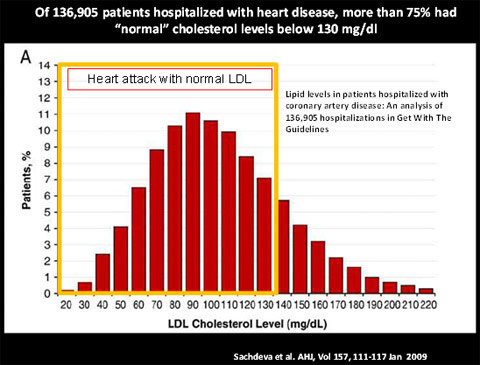
The graph has the same issues that I mentioned with the other study, in that it's a cross-sectional study that looks at the exposures and outcomes at the same time. What's really important in exposures is looking at it over time and tracking a trend. For instance, someone could've had high LDL for many years, then get a statin for a few, then develop a heart attack. The damage was done for years before starting therapy, they get a medication to reduce LDL, their LDL is normal, but because of the prior years of damage, they still get a heart attack. It's not like lowering the LDL will reduce the amount of plaque that has built up.The recent controversy stems from this data point.
I report, you decide.
.
Nah, but I enjoy epidemiology and trying to understand strengths and weaknesses with studiesThanks for those details. Are you a cardiologist or medical researcher? My cardiologist family member would agree with you.A few thoughts on the study and vid…
The purpose of the study was to identify a panel of lipid biomarkers associated with both dysglycemia and subclinical coronary atherosclerosis in an effort to identify risk associated with ASCVD.
Cross-sectional studies are always difficult to interpret because they collect both the exposure (diabetes, biomarkers) and outcomes (CACS) at the same time. The challenge is how do these variables affect the outcomes of interest since you're not measuring these variables over time, aka trend. That is to say, are these values normal, higher than normal, or lower than normal at the time they were measured? Their conclusion is "Changes in composition and relative concentration of HDL associated with both dysglycemia and subclinical coronary atherosclerosis", but the study isn't able to show these changes over time. To strengthen this study's findings, they should do a follow-up and track how these biomarkers change over months or years and how CACS changes or if/when ASCVD manifests.
An issue with their methods is they started off by looking at variables for 225 lipid biomarkers. When you have a type 1 error rate of 0.05 (a 5% chance of rejecting a true null hypothesis [that is there is no correlation]), you're going to find some variables by chance. Once they determined there were 32 biomarkers worth investigating further, they come to the conclusion that "None of the 32 glycemic profile-related lipid biomarkers was associated with relative increase of CACS in study participants with CACS>0 after adjustment for cardiovascular risk factors and dispensed lipid lowering drugs (Supplementary Table X), and no interaction was observed between any of the biomarkers and dispensed lipid lowering drugs or statin on CACS relative increase (Supplementary Table XI)."
Another general issues is how the study grouped these populations into averages. In the study, we see that people with diabetes have this average lipid biomarker level and an average CACS level, but we know there's variation within the population of those with higher and lower than the mean. One way to address this would've been to do a case-control approach where they looked at those with higher CACS scores and stratify by their exposure levels.
My issue with the YT video is the presenter starts off with "LDL cholesterol does not strongly correlate with the degree of coronary artery atherosclerosis". Again, as noted above, I don't think this is a strong argument based off how this study was conducted (cross-sectional) and their shotgun approach to testing every type of lipid biomarker (false positives). Yes, this study does seem to suggest that the difference between normal, pre-diabetic, and diabetic wasn't observed, but there are other observational studies that suggest there is benefit to lowering LDL.
https://www.sciencedirect.com/science/article/pii/S0939475324001650
Here is a meta-analysis of various cohort studies that patients with type 2 diabetes who were given a statin versus not and tracked overtime. The outcomes of measure were MACE and all-cause mortality. In this study, the level of baseline LDL did not show a statistical significance in relation to the absolute risk reduction of MACE or all-cause mortality. I think this study would've been more interesting to use to talk about LDL given that it is a meta-analysis of cohort studies and the outcomes are more interesting (MACE and death vs. CACS)

Honest question.The graph has the same issues that I mentioned with the other study, in that it's a cross-sectional study that looks at the exposures and outcomes at the same time. What's really important in exposures is looking at it over time and tracking a trend. For instance, someone could've had high LDL for many years, then get a statin for a few, then develop a heart attack. The damage was done for years before starting therapy, they get a medication to reduce LDL, their LDL is normal, but because of the prior years of damage, they still get a heart attack. It's not like lowering the LDL will reduce the amount of plaque that has built up.The recent controversy stems from this data point.
I report, you decide.
.
The graph doesn't provide a lot of other information that would be helpful in interpreting the information, like their age, ethnicity, diabetes, smoking, etc. It's possible that the people with normal LDL were all smokers and the higher LDL were all non-smokers. So some control of confounding variables would be more helpful in understanding the data.
Also, the study referenced in the chart argues for more aggressive LDL goals (down to 70, so that'd be only 20% of admits), so not exactly the same argument as in Derek's vid
There's a lot to comb through there, but I'll take one study as an example.Honest question.The graph has the same issues that I mentioned with the other study, in that it's a cross-sectional study that looks at the exposures and outcomes at the same time. What's really important in exposures is looking at it over time and tracking a trend. For instance, someone could've had high LDL for many years, then get a statin for a few, then develop a heart attack. The damage was done for years before starting therapy, they get a medication to reduce LDL, their LDL is normal, but because of the prior years of damage, they still get a heart attack. It's not like lowering the LDL will reduce the amount of plaque that has built up.The recent controversy stems from this data point.
I report, you decide.
.
The graph doesn't provide a lot of other information that would be helpful in interpreting the information, like their age, ethnicity, diabetes, smoking, etc. It's possible that the people with normal LDL were all smokers and the higher LDL were all non-smokers. So some control of confounding variables would be more helpful in understanding the data.
Also, the study referenced in the chart argues for more aggressive LDL goals (down to 70, so that'd be only 20% of admits), so not exactly the same argument as in Derek's vid
How do you interpret @MidWesternDoc’s opinion on Statins ?
.
Whenever looking into a health claim, it's always important to understand what populations were studied, what was being compared, and what was the outcome. Going back to my revised statement I made sure to frame it: "for people who are recovering from a coronary event" as the population "replacing animal fats with corn oil" was the comparison and "increases the risk of dying by 5.8%" was the outcome.@whatshouldicareabout
Thoughts on cardiologist Aseem Malhotra? Listening to him cite numbers, it seems any perceived benefit to Statins is in-fact statistically bleak.
.
