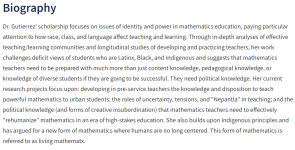
In this post-modernistic world, truth and objectivity are just mirages based on your identity[/s] race. So, we have post modern journalism in which pursuing "objectivity" is just imposing your racial view and the news needs to reflect these views to be reliable - or something. Following is the quick story about Jaime Escalante who taught his LatinX students white math to such a successful degree that his white administrators knew he was cheating and then once it was shown he wasn't then they got rid of him because it was embarrassing to have low income LatinX students learning white math. Then we have Rochelle Gutierrez on the state of Illinois university of payroll to "rehumanize" math and make sure we have LatinX math, Indian math, and black math. Apparently, Asian math is the same as white math so no attention needs to be given. "She also builds upon Indigenous principles and has argued for a new form of mathematics where humans are no long centered. This form of mathematics is referred to as living mathematx[/b]." Any student of her's is dead student walking.
View attachment 55464
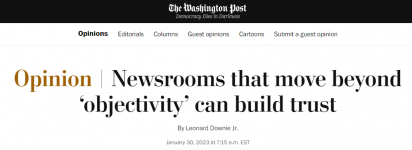
Now, the mainstream news media is coping with economic and digital disruption, along with increasing competition from misinformation on cable television and the internet. Meanwhile, American society itself has been in upheaval over discrimination against and abuse of women; persistent racism and white nationalism; police brutality and killings; the treatment of LGBTQ+ people; income inequality and social problems; immigration and the treatment of immigrants; the causes and effects of climate change; voting rights and election inequality; and even the very survival of our democracy. Reporting reliably on all of this has critically challenged newsrooms, calling into question their diversity, values and credibility.
Amid all the profound challenges and changes roiling the American news media today, newsrooms are debating whether traditional objectivity should still be the standard for news reporting. “Objectivity” is defined by most dictionaries as expressing or using facts without distortion by personal beliefs, bias, feelings or prejudice. Journalistic objectivity has been generally understood to mean much the same thing.
But increasingly, reporters, editors and media critics argue that the concept of journalistic objectivity is a distortion of reality. They point out that the standard was dictated over decades by male editors in predominantly White newsrooms and reinforced their own view of the world. They believe that pursuing objectivity can lead to false balance or misleading “bothsidesism” in covering stories about race, the treatment of women, LGBTQ+ rights, income inequality, climate change and many other subjects. And, in today’s diversifying newsrooms, they feel it negates many of their own identities, life experiences and cultural contexts, keeping them from pursuing truth in their work....
Now, the mainstream news media is coping with economic and digital disruption, along with increasing competition from misinformation on cable television and the internet. Meanwhile, American society itself has been in upheaval over discrimination against and abuse of women; persistent racism and white nationalism; police brutality and killings; the treatment of LGBTQ+ people; income inequality and social problems; immigration and the treatment of immigrants; the causes and effects of climate change; voting rights and election inequality; and even the very survival of our democracy. Reporting reliably on all of this has critically challenged newsrooms, calling into question their diversity, values and credibility.
=========
https://www.powerlineblog.com/archives/2023/01/mathematx.php
MATHEMATX
Sometime back around 1990, I was privileged to get to spend some time with Jaime Escalante (d. 2010), the Bolivian-born high school math teacher whose compelling story was made into a feature film, Stand and
Deliver.
Escalante had become nationally famous in the 1980s when 18 of his hispanic students from a low-income east Los Angeles neighborhood scored highly on the AP calculus test in 1982. (The next year, 30 more of his students scored high on the AP test.) It was initially thought that these students must have cheated, because this never happens.
No—it really did happen, because Escalante was a gifted math teacher. His view was that every student could master calculus if they were willing to put in the work. That was the key point: He knew that you can’t master calculus in just 50 minutes a day watching a teacher at the blackboard. He motivated his students to come in after school and on Saturdays for extra hands-on work with him. And “hands-on” it was: he’d spend as much time one-on-one with with students as they needed to get beyond a hurdle. And then do it again the next day.
He was unfailingly supportive of every student, especially if they were struggling with the subject. He was never harsh with students, but neither would he accept excuses. Enrollment in his math classes at Garfield High School, and the number of his students taking the AP test quickly grew to over 500.
You know what happened next: jealous and resentful fellow teachers hounded him out of Garfield High...
To be sure, Escalante is a rare teacher. He was absolutely riveting in person. And while that kind of genius can’t be easily acquired, it can be studied and emulated as an example of human excellence and effective pedagogy. I suspect the number of education schools that teach a case study about Escalante (or Marva Collins, who I also met once) is precisely zero.
Instead of Escalante’s challenge, students at the University of Illinois they will get this:
View attachment 55465