

You are using an out of date browser. It may not display this or other websites correctly.
You should upgrade or use an alternative browser.
You should upgrade or use an alternative browser.
Maximum Carnage Week Game Thread
- Thread starter Swaye
- Start date

Go figure. Who knew? Definitely not that Man of Science Fow Chee or the dazzler. These people need to be punished. Like piano wire punished.
https://ace.mu.nu/
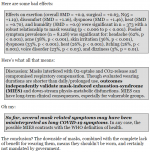
Study: Mask-Wearing is Harmful, Lowering Blood Oxygen Levels and Increasing Blood CO2, as Well as Increasing Heart Rate and Blood Pressure
—Ace
In other words, masks make it more difficult to breathe.
Shocking discovery, I know.

https://ace.mu.nu/
Study: Mask-Wearing is Harmful, Lowering Blood Oxygen Levels and Increasing Blood CO2, as Well as Increasing Heart Rate and Blood Pressure
—Ace
In other words, masks make it more difficult to breathe.
Shocking discovery, I know.

46XiJCAB
New Fish
http://twitter.com/RobertKennedyJr/status/1646567252031066112?t=-T-r-RbdHSdlJnm875LagQ&s=19
PBS has pulled out of Twitter. That’s two leftists and government propaganda orgs down.
RFK Jr. with the straight fire!
Last edited:

http://twitter.com/RobertKennedyJr/status/1646567252031066112?t=-T-r-RbdHSdlJnm875LagQ&s=19
PBS has pulled out of Twitter. That’s two leftists and government propaganda orgs down.
RFK Jr. with the straight fire!
Hell I would vote for him


https://twitter.com/WarClandestine/status/1647755545124782080
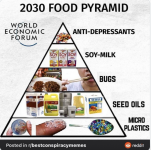
Fow Chee had no interest in who and how it was engineered although he was initially very proud of his funding of the Chicom gain of function research into bat coronaviruses because of the obvious benefits to Pfizer[/s] uh, humanity. Even today, the US government medical bureaucracy and the US Congress has no interest in what happened and more importantly was is happening today.

46XiJCAB
New Fish
http://twitter.com/michaelpsenger/status/1648748890789920769?t=UufmFOYGRrDWKwicJDwflA&s=19
Dazzler believed her the first time.
http://twitter.com/michaelpsenger/status/1648748890789920769?t=UufmFOYGRrDWKwicJDwflA&s=19
"An evolution of science." Translating, "we had no evidence of the effectiveness of the vaccine or the length of any effectiveness, so we just lied about it rather than run any actual trials. Furthermore, we ignored natural immunity and made people get the vaxx even though they had just recovered from a covid infection. Finally, we knew vaccines against respiratory viruses provided limited protection, so again, we just lied that the covid vaccines would give a person immunity and that they couldn't spread the virus."
https://cei.org/opeds_articles/fauci-changes-his-public-tune-on-covid-vaccines/
Dr. Anthony Fauci has finally acknowledged that there had always been good scientific reasons to believe that vaccines against the respiratory virus that causes Covid-19 — SARS-CoV-2 — would provide limited protection against infection that would not be long-lasting. That is precisely what happened: It quickly became apparent that protection against transmission lasted just a few months, and initial effectiveness declined as each new viral variant proved more contagious than its predecessor. Yet Fauci insisted that repeated vaccines were needed for everyone and until recently pushed for vaccine mandates. This has resulted in shortages of essential workers, poorer educational outcomes, and diminished trust in public-health authorities.
Last month in an article in the journal Cell Host & Microbe, Fauci wrote that vaccines against respiratory viruses generally provide “decidedly suboptimal” protection against infection and rarely produce durable, protective immunity.[/b] The reason is that most of these viruses, such as influenza, which causes the flu, and SARS-CoV-2, have short incubation periods during which they infect the respiratory mucosa and rapidly replicate there without spreading systemically. Moreover, according to Fauci, the human immune system has evolved to tolerate respiratory viruses during short intervals of mucosal viral replication. This leads to illness and onward transmission without eliciting a systemic immune response.
These factors negate the effectiveness of vaccines, which typically rely on systemic responses to viral exposures. Respiratory viruses that replicate rapidly in the mucosa cause short-duration illnesses and transmission to others all before the immunologic defenses put in place by vaccines can be brought to bear. Vaccines against the influenza virus that causes the flu, for example, have averaged only 40 percent effectiveness against infection over the last 17 influenza seasons, ranging from 10 to 60 percent. And, as Fauci acknowledged, “the duration of vaccine-elicited immunity is measured only in months.”[/b]



TurdBomber
Active poster
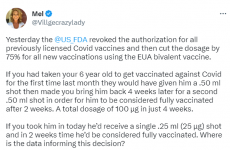
https://twitter.com/Villgecrazylady/status/1648773105114832897?s=20
Credit: HoustonHusky's Twat Act
Credit: HoustonHusky's Twat Act
https://twitter.com/Villgecrazylady/status/1648773105114832897?s=20
Credit: HoustonHusky's Twat Act
Frankly, if you gave your six year old the vaxx, you should be charged with child abuse along with your doctor. Geezus. I'd never vote for a commie leftist like Bobby Jr. but he was nails on the vaxx. Really, it wasn't that hard unless you were on the Pfizer payroll like our government (fed and state) medical bureaucracy.
Maybe lose some weight babe
http://twitter.com/SonoraSmile/status/1649135946934153236?t=vbkbg8Jii0f9IZdlZlOLpQ&s=19
http://twitter.com/SonoraSmile/status/1649135946934153236?t=vbkbg8Jii0f9IZdlZlOLpQ&s=19

Gym bro, whose wife has volleyball tits, is running for Mayor of Toronto.
https://twitter.com/chrissaccoccia1/status/1649202893990379522?s=46&t=TF5YSHjB9Hq6ZBrenucnTg
https://twitter.com/chrissaccoccia1/status/1649202893990379522?s=46&t=TF5YSHjB9Hq6ZBrenucnTg
Last edited: