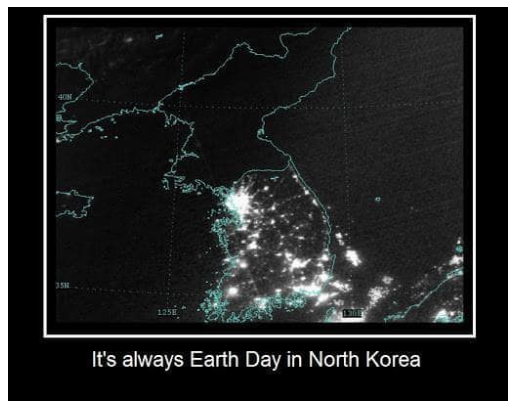
It's your duty to freeze in the dark.

That’s the Los Angeles Times in 1901. How about this one?“The electric automobile will quickly and easily take precedence over all other kinds of motor carriages as soon as an effective battery of light weight is discovered.”
That’s the Washington Post, 1915.“Prices on electric cars will continue to drop until they are within reach of the average family.”
There are now murmurings that Tesla could go bankrupt. I like Elon Musk, and we need him: I fervently hope that he has gotten most of his money out of Tesla.Tesla is the bellwether for the EV business, and it’s in trouble. Last week, the company announced it was laying off more than 10%, or about 14,000, of its employees. The move comes after a quarter during which the company missed delivery expectations and just before it reveals its quarterly profits on Tuesday. Here’s what Wired wrote last Thursday about Tesla’s situation: “Demand is dropping for electric cars in the U.S. and Europe, just as competition in China intensifies and workers revolt in Europe. Investors are worried.”
Electric vehicles will always be much more expensive than internal combustion vehicles because they need vast quantities of raw materials:In 2019, Southern California Edison, one of the biggest investor-owned utilities in California, estimated the amount of juice needed to electrify transportation in the state. The utility found that trying to do so “will increase electric load by nearly 130 terawatt hours — representing more than one-third of the grid-served load” by 2045. The same report estimated the state will need to add at least 80 gigawatts of new zero-carbon electricity generation capacity over the next two decades. But … California’s electricity use is falling. Some of that decline is due to people and industry leaving the state. The other factor may be the high cost of power in the state. Further, California will not add 80 GW of new generation capacity over the next 20 years. The permitting process is far too long, and the costs of trying to do so are too high.
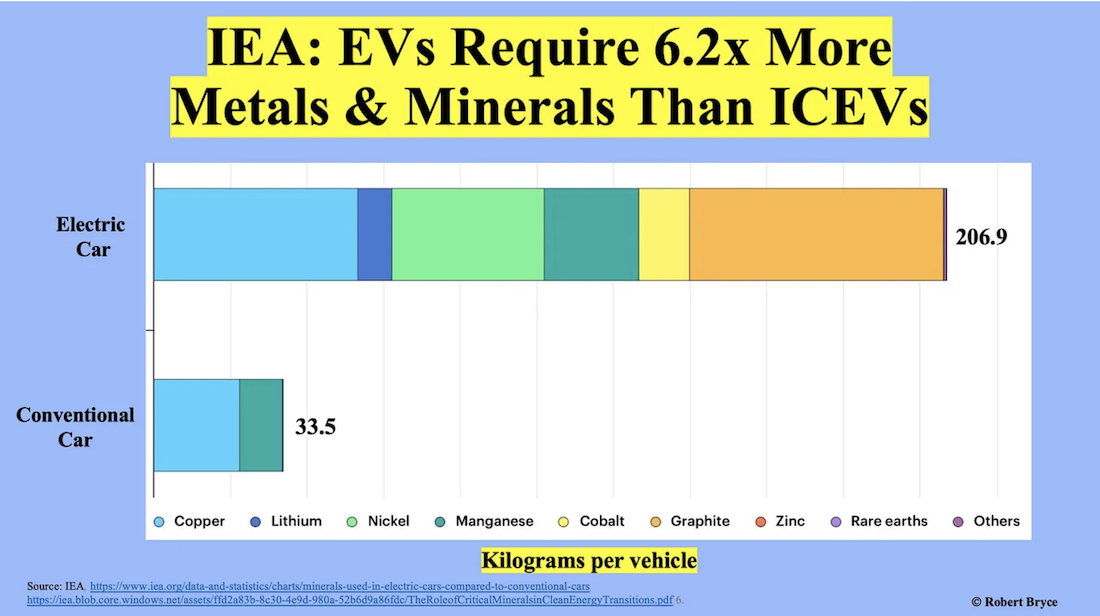
EVs require massive amounts of metals, minerals, and magnets. This chart uses a screengrab from a 2021 report by the International Energy Agency called “The Role of Critical Minerals in Clean Energy Transitions.”
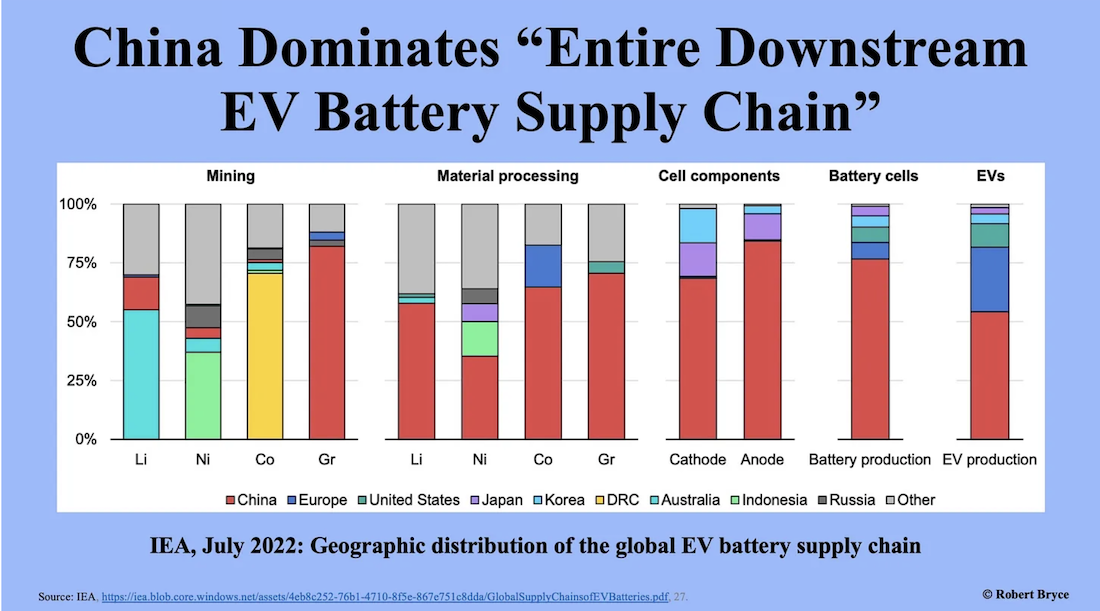
This chart tells the story:Last month, the Biden Administration finalized rules requiring U.S. automakers to slash the number of internal combustion-engined vehicles they produce. By 2032, about 60% of the cars they sell must be fully electric. Why, in the name of Jesus, Mary, and Joseph, is the Biden crowd so eager to make our auto sector dependent on Chinese supply chains?
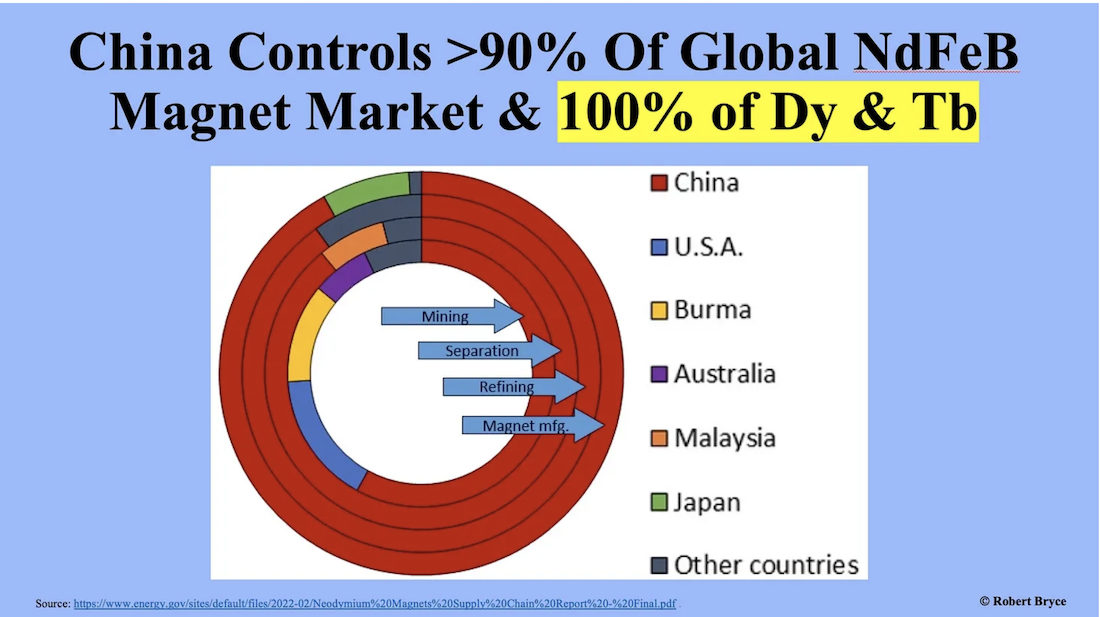
Last May, in “The EPA’s China Syndrome,” I explained how the proposed mandate on EVs would make the U.S. dependent on China for “neodymium-iron-boron (NdFeB) magnets. Those magnets are critical components in electric vehicles and wind turbines as well as in military applications like ship propulsion systems and guided-missile actuators.” The EPA has completely ignored the magnet supply issue. In fact, the word “magnet” doesn’t appear one time in the agency’s 1,200-page final tailpipe rule.
This is pure foolishness. In 2022, the Commerce Department issued a heavily redacted report on Chinese magnets and the threat they pose to our security.