
You are using an out of date browser. It may not display this or other websites correctly.
You should upgrade or use an alternative browser.
You should upgrade or use an alternative browser.
Greatest Engine Invention in Human History?
- Thread starter YellowSnow
- Start date


Steam Punks unite !We went from no engines to steam engines, and nothing better or even different came around for a long time. Easy pick.


Yella not a fan of incremental progress"Greatest" is subjective obviously. I'm looking at through the lens of what changed life for sapiens the most. Have you read Sapiens yet @whlinder btw? Great read.The question was greatest
The current speed and reliability of transport by high bypass turbofans is super impressive. The impact of steam turbines was probably higher as the starting point was lower. Is greatest measured by margin improvements or top end ability?
Engine performance is not completely correlated to airframe safety, but the 338 DC-7s produced killed 714 people. The nearly 2000 787s and A350s in service haven't killed a passenger.
Current levels of commercial air travel are certainly one of man kind's greatest (recent) achievements and engines play a part in that. I mean there's a reason why we can fly from San Francisco to Sydney on a wide body and only need 2 engines. But comparing a DC-7 to a 787 on safety is like comparing my wife's Audi Allroad Wagon with a 2.0 turbo to @RaceBannon 's 1956 Chevy. They both are internal combustion technology.

All of these marvelous inventions have experienced incremental progress.Yella not a fan of incremental progress"Greatest" is subjective obviously. I'm looking at through the lens of what changed life for sapiens the most. Have you read Sapiens yet @whlinder btw? Great read.The question was greatest
The current speed and reliability of transport by high bypass turbofans is super impressive. The impact of steam turbines was probably higher as the starting point was lower. Is greatest measured by margin improvements or top end ability?
Engine performance is not completely correlated to airframe safety, but the 338 DC-7s produced killed 714 people. The nearly 2000 787s and A350s in service haven't killed a passenger.
Current levels of commercial air travel are certainly one of man kind's greatest (recent) achievements and engines play a part in that. I mean there's a reason why we can fly from San Francisco to Sydney on a wide body and only need 2 engines. But comparing a DC-7 to a 787 on safety is like comparing my wife's Audi Allroad Wagon with a 2.0 turbo to @RaceBannon 's 1956 Chevy. They both are internal combustion technology.

Todd Turner to defend Ty
Diesel is vastly underrated in this exercise. It's hard to imagine a world without diesel given it's role in agriculture, mining, construction, etc. It's the most efficient engine of them all. I think the only thing which puts the gas ICE ahead of diesel is its role on aviation. You're not putting diesel engines in B-29s or P-51s.being the owner of 2 vehicles powered by I had to vote this way. Plus I felt sorry that Diesel had no votes

1to392831weretaken
New Fish
Fuck Vanilla, so @YellowSnow wrote:
"Diesel is vastly underrated in this exercise. It's hard to imagine a world without diesel given it's role in agriculture, mining, construction, etc. It's the most efficient engine of them all. I think the only thing which puts the gas ICE ahead of diesel is its role on aviation. You're not putting diesel engines in B-29s or P-51s."
Not even close.
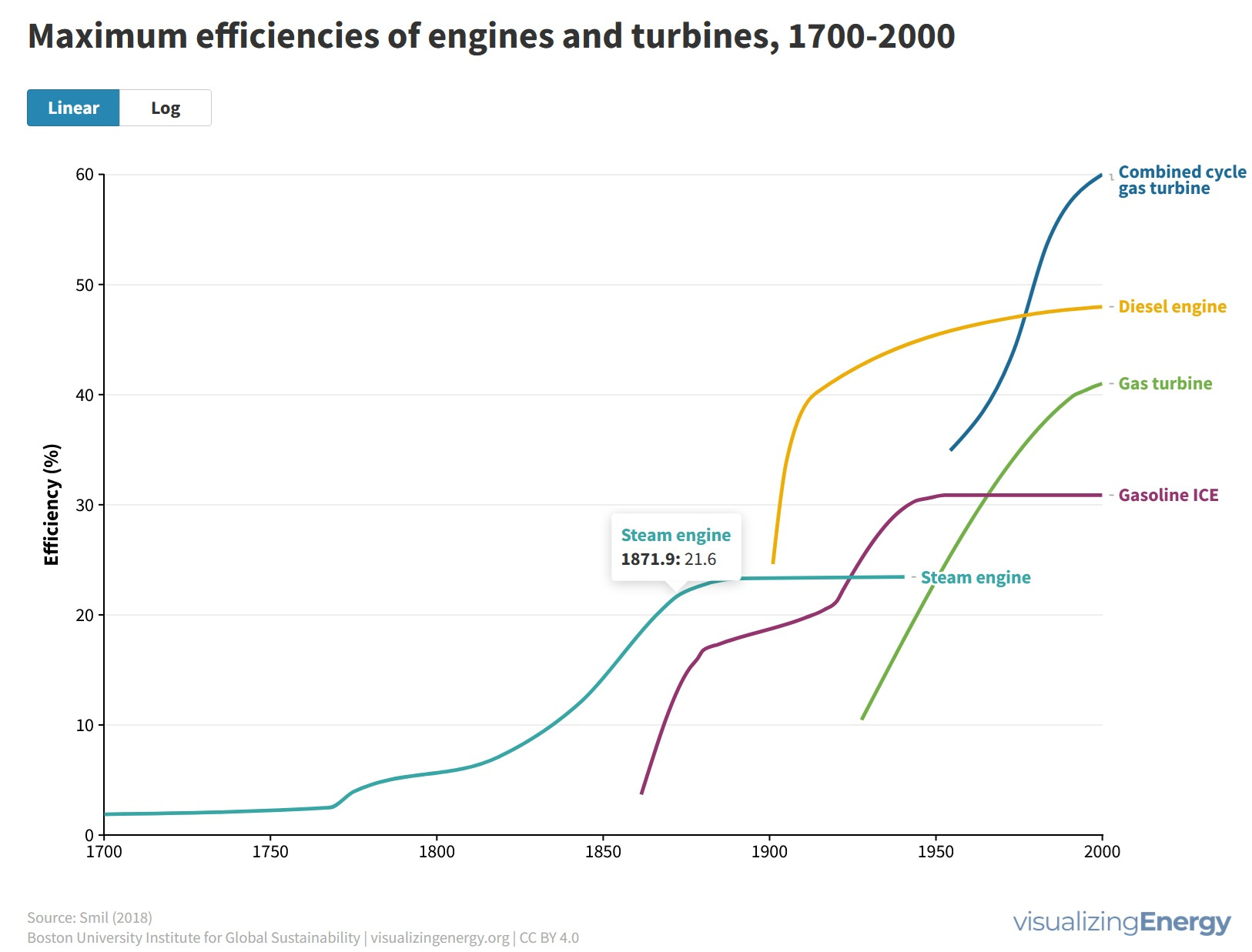
This chart doesn't include Stirling engines, which have an even higher theoretical maximum thermal efficiency, although it's just a lesser explored design. And it's also strictly thermal efficiency. From a power density standpoint, diesel falls even further behind.
And, yes, I've been an oil man for over 20 years. That doesn't mean I don't consider it to be an amazing stepping stone whose time has passed. I'm like the deckhand on the last whaling ship or the guysm trying to develop lighter, crisper buggy whips in 1910.
Speaking of steam, this is somewhat a fascination of mine as I wander the ol' workplace. It's such a steampunk concept: I leave a modern control room full of 80" 8K monitors and massive touchscreens and PID control, follow thousands of miles of fiber optic cable out into a process unit where we're boiling explosive material and moving it with steam. I'm constantly thinking, "How is this 2024?"
"Diesel is vastly underrated in this exercise. It's hard to imagine a world without diesel given it's role in agriculture, mining, construction, etc. It's the most efficient engine of them all. I think the only thing which puts the gas ICE ahead of diesel is its role on aviation. You're not putting diesel engines in B-29s or P-51s."
Not even close.
This chart doesn't include Stirling engines, which have an even higher theoretical maximum thermal efficiency, although it's just a lesser explored design. And it's also strictly thermal efficiency. From a power density standpoint, diesel falls even further behind.
And, yes, I've been an oil man for over 20 years. That doesn't mean I don't consider it to be an amazing stepping stone whose time has passed. I'm like the deckhand on the last whaling ship or the guysm trying to develop lighter, crisper buggy whips in 1910.
Speaking of steam, this is somewhat a fascination of mine as I wander the ol' workplace. It's such a steampunk concept: I leave a modern control room full of 80" 8K monitors and massive touchscreens and PID control, follow thousands of miles of fiber optic cable out into a process unit where we're boiling explosive material and moving it with steam. I'm constantly thinking, "How is this 2024?"
Last edited:
Call me Ishmael!Fuck Vanilla, so @YellowSnow wrote:
"Diesel is vastly underrated in this exercise. It's hard to imagine a world without diesel given it's role in agriculture, mining, construction, etc. It's the most efficient engine of them all. I think the only thing which puts the gas ICE ahead of diesel is its role on aviation. You're not putting diesel engines in B-29s or P-51s."
Not even close.
This chart doesn't include Stirling engines, which have an even higher theoretical maximum thermal efficiency, although it's just a lesser explored design. And it's also strictly thermal efficiency. From a power density standpoint, diesel falls even further behind.
And, yes, I've been an oil man for over 20 years. That doesn't mean I don't consider it to be an amazing stepping stone whose time has passed. I'm like the deckhand on the last whaling ship or the guysm trying to develop lighter, crisper buggy whips in 1910.
Speaking of steam, this is somewhat a fascination of mine as I wander the ol' workplace. It's such a steampunk concept: I leave a modern control room full of 80" 8K monitors and massive touchscreens and PID control, follow thousands of miles of fiber optic cable out into a process unit where we're boiling explosive material and moving it with steam. I'm constantly thinking, "How is this 2024?"
Steam will never die. You can't put split atoms in a piston or a turbine.
Fucking Todd Turner.Todd Turner to defend Ty
And today's UW Freshman and Sophomores were born during Ty's vicious animal understanding. CHRIST
Also, boss, we're not talking about power plants here. We're talking about engines to that do mechanical work.Fuck Vanilla, so @YellowSnow wrote:
"Diesel is vastly underrated in this exercise. It's hard to imagine a world without diesel given it's role in agriculture, mining, construction, etc. It's the most efficient engine of them all. I think the only thing which puts the gas ICE ahead of diesel is its role on aviation. You're not putting diesel engines in B-29s or P-51s."
Not even close.
This chart doesn't include Stirling engines, which have an even higher theoretical maximum thermal efficiency, although it's just a lesser explored design. And it's also strictly thermal efficiency. From a power density standpoint, diesel falls even further behind.
And, yes, I've been an oil man for over 20 years. That doesn't mean I don't consider it to be an amazing stepping stone whose time has passed. I'm like the deckhand on the last whaling ship or the guysm trying to develop lighter, crisper buggy whips in 1910.
Speaking of steam, this is somewhat a fascination of mine as I wander the ol' workplace. It's such a steampunk concept: I leave a modern control room full of 80" 8K monitors and massive touchscreens and PID control, follow thousands of miles of fiber optic cable out into a process unit where we're boiling explosive material and moving it with steam. I'm constantly thinking, "How is this 2024?"
1to392831weretaken
New Fish
Also, boss, we're not talking about power plants here. We're talking about engines to that do mechanical work.Fuck Vanilla, so @YellowSnow wrote:
"Diesel is vastly underrated in this exercise. It's hard to imagine a world without diesel given it's role in agriculture, mining, construction, etc. It's the most efficient engine of them all. I think the only thing which puts the gas ICE ahead of diesel is its role on aviation. You're not putting diesel engines in B-29s or P-51s."
Not even close.
This chart doesn't include Stirling engines, which have an even higher theoretical maximum thermal efficiency, although it's just a lesser explored design. And it's also strictly thermal efficiency. From a power density standpoint, diesel falls even further behind.
And, yes, I've been an oil man for over 20 years. That doesn't mean I don't consider it to be an amazing stepping stone whose time has passed. I'm like the deckhand on the last whaling ship or the guysm trying to develop lighter, crisper buggy whips in 1910.
Speaking of steam, this is somewhat a fascination of mine as I wander the ol' workplace. It's such a steampunk concept: I leave a modern control room full of 80" 8K monitors and massive touchscreens and PID control, follow thousands of miles of fiber optic cable out into a process unit where we're boiling explosive material and moving it with steam. I'm constantly thinking, "How is this 2024?"
Uh, you don't think spinning huge shaft attached to a huge generator to generate metric shitloads of energy is doing mechanical work? If spinning a shaft isn't doing mechanical work, the steam engine doesn't count either. You could always modify the title of the pole to "transportation engines" and I'll rescind combined cycle turbines.
And search engines…

1to392831weretaken
New Fish
Without all those engines getting my Amazon garbage to me, is the internet even worth it?Between Engine and Internet which is most important over last 100 years?
Oh yeah, porn.
Totally the internet.

I spin my huge shaft almost daily.Also, boss, we're not talking about power plants here. We're talking about engines to that do mechanical work.Fuck Vanilla, so @YellowSnow wrote:
"Diesel is vastly underrated in this exercise. It's hard to imagine a world without diesel given it's role in agriculture, mining, construction, etc. It's the most efficient engine of them all. I think the only thing which puts the gas ICE ahead of diesel is its role on aviation. You're not putting diesel engines in B-29s or P-51s."
Not even close.
This chart doesn't include Stirling engines, which have an even higher theoretical maximum thermal efficiency, although it's just a lesser explored design. And it's also strictly thermal efficiency. From a power density standpoint, diesel falls even further behind.
And, yes, I've been an oil man for over 20 years. That doesn't mean I don't consider it to be an amazing stepping stone whose time has passed. I'm like the deckhand on the last whaling ship or the guysm trying to develop lighter, crisper buggy whips in 1910.
Speaking of steam, this is somewhat a fascination of mine as I wander the ol' workplace. It's such a steampunk concept: I leave a modern control room full of 80" 8K monitors and massive touchscreens and PID control, follow thousands of miles of fiber optic cable out into a process unit where we're boiling explosive material and moving it with steam. I'm constantly thinking, "How is this 2024?"
Uh, you don't think spinning huge shaft attached to a huge generator to generate metric shitloads of energy is doing mechanical work? If spinning a shaft isn't doing mechanical work, the steam engine doesn't count either. You could always modify the title of the pole to "transportation engines" and I'll rescind combined cycle turbines.
And search engines…
I don’t consider it work.
1to392831weretaken
New Fish
You SPIN it!? You might want to see a doctor.

ukdawg
Member
Gas turbine engines (Jets) can run on any fuel, which I guess is also true of steam engines since anything can heat water. And, if you think about nearly all of our energy comes from steam driven turbines (even fusion reactors - if they ever work - will eventually use steam to generate electricity). So, I'd say it's tie between Jet and Steam.
Possible tie breaker - there is no such thing as a "Cleveland Jetter"
Possible tie breaker - there is no such thing as a "Cleveland Jetter"
I don’t like including power generation in the engine category, but I will concede the point. If a diesel generator at a hospital is an engine, then I guess we have to count a gas turbine burning cow farts.Also, boss, we're not talking about power plants here. We're talking about engines to that do mechanical work.Fuck Vanilla, so @YellowSnow wrote:
"Diesel is vastly underrated in this exercise. It's hard to imagine a world without diesel given it's role in agriculture, mining, construction, etc. It's the most efficient engine of them all. I think the only thing which puts the gas ICE ahead of diesel is its role on aviation. You're not putting diesel engines in B-29s or P-51s."
Not even close.
This chart doesn't include Stirling engines, which have an even higher theoretical maximum thermal efficiency, although it's just a lesser explored design. And it's also strictly thermal efficiency. From a power density standpoint, diesel falls even further behind.
And, yes, I've been an oil man for over 20 years. That doesn't mean I don't consider it to be an amazing stepping stone whose time has passed. I'm like the deckhand on the last whaling ship or the guysm trying to develop lighter, crisper buggy whips in 1910.
Speaking of steam, this is somewhat a fascination of mine as I wander the ol' workplace. It's such a steampunk concept: I leave a modern control room full of 80" 8K monitors and massive touchscreens and PID control, follow thousands of miles of fiber optic cable out into a process unit where we're boiling explosive material and moving it with steam. I'm constantly thinking, "How is this 2024?"
Uh, you don't think spinning huge shaft attached to a huge generator to generate metric shitloads of energy is doing mechanical work? If spinning a shaft isn't doing mechanical work, the steam engine doesn't count either. You could always modify the title of the pole to "transportation engines" and I'll rescind combined cycle turbines.
And search engines…