Here's some light reading, because inquiring minds want to know
https://sgp.fas.org/eprint/egan.pdf
While not pertinent to the Article II powers of the actual President, the dissent sets out the correct view of Presidential powers.
=========
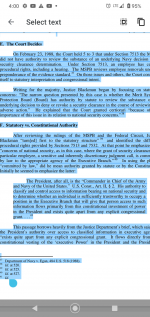
Dissenting in this case, Chief Judge Markey insisted that the “authority to grant or
deny a security clearance is committed to the sound discretion of executive agency heads.
See Exec. Order 10450 . . .”19 He objected that the majority’s decision “will dilute the
responsibility the President placed on” the armed services and executive agencies and ran
“clearly contrary to well-established principles of deference owed national security
determinations of executive agencies.”20 To him, the protection of classified information
“is an executive responsibility flowing from the President’s constitutional mandate to
provide for the national defense. U.S. Const., Art. II, § 2.”21 Section 2 of Article II does
not vest all of national defense in the President. Important powers and duties are
expressly reserved to Congress under Article I. One problem with a national security
case like Egan is that the Justice Department is always present to defend and promote
executive power but the attorney representing the private party is in no position, either
through capacity or incentive, to defend and promote congressional power.