I’m not going to try to downplay the import of population growth to recruiting. I will put it in perspective. Let’s start off with some data:
~250,000 seniors in high school football
~1,400 P-5 FBS scholarships awarded per year
About a 0.5% chance, let’s call it 1/200.
There are 1.8 million boys who are high school seniors, and with 250k playing football it means one in 7.2 is playing football. That would mean out of 100,000 boys aged 18 you get 14,000 football players.
One out of 200 means that’s 70 P-5 scholarship football players.
Wow, but how many people does it take to get 100,000 18 year old boys? If the US population is 330 million and if age is distributed evenly by region that’s gonna be a little over 18 million.
18 million population growth is needed to produce 70 additional P-5 football players per year.
Then there’s a caveat. A touchy one.
Utah isn’t producing more talent because John and Angie gave birth to Kayden, Brayden, Tylan, Ibuprofan, Maverick, and Nebuchadnezzar in five years. It’s because Angie’s great-grandfather went to Samoa to recruit people for his cult, John’s dad cares about football as do his friends, there’s lots of space for football fields, the weather is okay to play in, and football is socially important so people play it instead of doing something else.
Polynesians, however, are a minor percentage of FBS football players. They’re over represented statistically per capita, but not as significant as African Americans - which, according to the NCAA, 48% of D-1 scholarship football players are. Making up 14% of the population that would mean they are 3.5x more likely to be a D-1 football player.
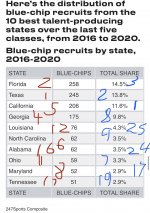
Shitty chart below, excuse my graphics guy Michael J Fox, shows the states that have produced the most blue chips over a five year span. Florida is number one due to IMG recruits counting for them, without they would be number two I believe.
Red is the state’s ranking in the population of AA while blue is the total population ranking. More on this later.
View attachment 40146
If that 18 million has the state of Washington’s 6% population rate of AA, let’s bump it up to 7% with changing demographics, that means that you’re not having 70 recruits per year but fewer. About 56. Let’s forget about the West Coast’s higher percentage of those who don’t play in Rose Bowls or prefer the other football and call it 60.
What percentage of those P-5 recruits are blue chips? Let’s be generous and call it 25% based on 350 blue chips per year. Out of our pool of 60 per year that means 15 will be blue chips.
From 2010-2020 Washington’s population increased by a little under one million people. Which yields about six extra blue chips per five year cycle. Not an insignificant difference to the makeup of a roster, but also not a game changer.
To go back to the earlier part about states by population, why do Louisiana and Alabama overproduce talent compared to New York and Illinois? There are still some demographic reasons, but mostly culture and geography.
As far as the decline of participation, I’ll touch on that briefly. In a sport dependent on athleticism like football it doesn’t matter too much for high end talent. Those with the physical gifts necessary will still be drawn to it, and others not getting developed doesn’t matter too much because the vast majority don’t have the genetics necessary to matter. Thanks for coming to my TED talk and please enjoy your bleach cocktail.